Dongguan + Nov 30, 2022 18:30:20
The population is the basis of all economic and social activities, and young talents are the priority resource for urban development. Recently, Zhilian Recruitment and Zeping Hongguan released the “China’s most attractive city for post-95s talents in 2022” (hereinafter referred to as “the report”). The report focuses on post-95s talents, to explore the mobility trend of post-95s job seekers. The report shows the list of the top 50 most attractive cities for post-95s talents in China, among which Beijing, Shenzhen and Shanghai are in the top; meanwhile, post-95s talents prefer developed cities such as cities in the Yangtze River Delta and Pearl River Delta. It is worth mentioning that Dongguan’s attractiveness rose from 21st place in 2021 to 14th place this year, an improvement of 7 places.
Uncovering the characteristics of post-95s job-seekers:
Difference between living cities and resume-sending cities
According to the report, there are about 260 million post-95s in China (born in 1995-2009, now aged 12-26), and about 200 million post-95s of working age (aged 16-26), accounting for 22.7% of the working-age population in 2020. Zhilian Recruitment has about 290 million users, with an average monthly active user of about 46.32 million; nearly 9% of them are college-educated or above, far exceeding 22.1% of the national employed population as a whole. Among the job-seeking talents, about 52% are aged 16-27, the post-95s talents referred to in this paper; among which about 50% are cross-city job seekers (their current living city is different from the city to which the resume is directed), which is a higher percentage than the overall proportion of cross-city job seekers (40%) in the country. In this article, we use the overall and post-95s job seeker behavior data from Zhilian Recruitment for comparison and try to explore the characteristics and flow trends of post-95s job search talent.
From the gender point of view, the proportion of post-95s female job seekers is relatively higher, because 50% of the post-95s cross-city job seekers are female, higher than the overall number of 42% nationwide. From the education point of view, 54% of the post-95s migrant talents have a bachelor's degree or above, lower than the overall number of 56%. From the wage point of view, since the post-95s is a newcomer to the workplace with a low wage level, migrant talents with a monthly income of less than 6K accounted for 69.3%, much higher than the overall. From the industry point of view, the post-95s are more distributed in the emerging industries, and the migrant talents in the IT industry account for 24.0%, higher than the overall number of 18.7%, while in the real estate and manufacturing industries together account for 25.1%, significantly lower than the overall number of 33.3%.
Beijing, Shenzhen and Shanghai are in the top
Top 50 attractive cities
According to the report, China’s top 50 most attractive cities for post-95s talent are as followed: Beijing, Shenzhen, and Shanghai topped the list, with Dongguan in 14th place.
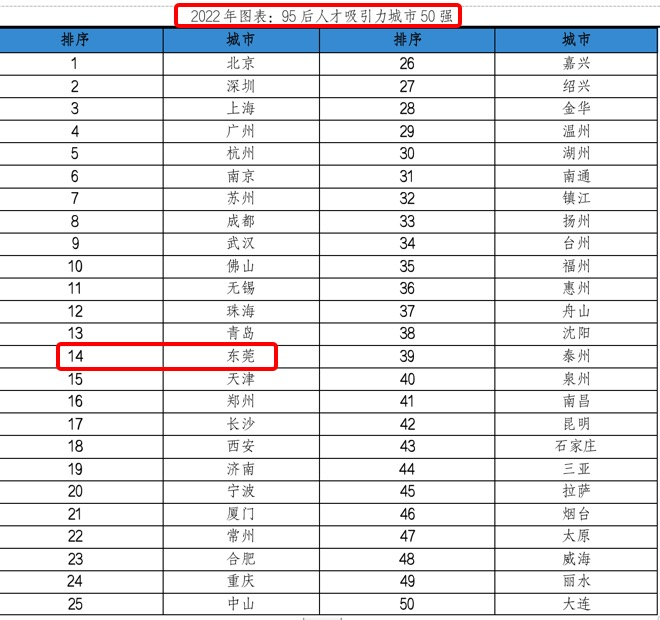
The report shows that the post-95s young talents grow up in an era of rapid economic growth and affluent life, and they prefer the work-life balance. Based on data availability, this article selects per capita disposable income, the number of patents granted per 10,000 people, and the number of cinemas per million people as external indicators, and superimposes four internal indicators provided by Zhilian Recruitment, namely, the proportion of post-95s talent inflow, the proportion of post-95s talent net inflow, the proportion of post-95s talent inflow of fresh graduates and the proportion of post-95s talent inflow of masters and above, to construct the post-95s talent attractiveness index. From the results, Beijing, Shenzhen, and Shanghai are in the top three, followed by Guangzhou, Hangzhou, Nanjing, Suzhou, Chengdu, Wuhan, and Foshan.
Interpretation of sub-indicators: Tier 1 and Tier 2 cities attract highly educated talents, and Guangdong and Suzhou have high innovation vitality. Looking at the top cities in each sub-index, in terms of high education, first-tier cities and strong second-tier cities such as Chengdu, Nanjing and Hangzhou ranked top; in terms of income, Beijing and Shanghai, and the Yangtze River Delta region cities have more advantages; in terms of innovation, Guangdong and Suzhou cities have stronger innovation vitality, especially Shenzhen; in terms of recreation and culture, tourism cities Sanya and Lhasa ranked top, driving the overall index ranking to be among the top 50.
Dongguan is in 14th place, up by 7 positions
Young talents prefer the Yangtze River Delta and Pearl River Delta
In terms of the Post-95s Talent Attractiveness Index, Beijing, Shenzhen, and Shanghai are in the top three, followed by Guangzhou, Hangzhou, Nanjing, Suzhou, Chengdu, Wuhan, and Foshan in the top 10. Previously, the Talent Attractiveness Ranking of Chinese Cities: 2022 has defined the Talent Attractiveness Index as the weighted result of talent inflow share, talent net inflow share, talent inflow share of fresh graduates, talent inflow share of masters and above, per capita disposable income, and net population inflow.
According to the data of “Zeping Hongguan”, the post-95s young talents grew up in the era of rapid economic growth and affluent life, prefer work-life balance, and pay attention not only to salary but also to the innovation environment and the development of cultural and entertainment industries when choosing employment cities. Based on the availability of data, this article selects the per capita disposable income, the number of patents granted, and the number of cinemas per million people as external indicators, and superimposes the four internal indicators of post-95s talent inflow, the net inflow of post-95s talent, the inflow of post-95s fresh graduates and the inflow of post-95s masters and above provided by Zhilian Recruitment to construct the post-95s talent attractiveness index.
From the results, Beijing, the political, economic, and cultural center, topped the list for the past two years; Shenzhen came in second and is more attractive to young talent after 95 than Shanghai overall. According to our selected innovation indicators, Shenzhen ranks first among the top 20, while Shenzhen has a lower settlement threshold than Beijing and Shanghai. With the restricted population carrying capacity, young talents will also actively seize the talent heights when Shenzhen tightens the settlement threshold, and the innovative industrial structure and lower settlement threshold attract young people to work in Shenzhen. Shanghai and Guangzhou rank third and fourth separately; second-tier cities Hangzhou, Nanjing, Suzhou, Chengdu, Wuhan, and Foshan are among the top ten, of which Suzhou is up by 1 place than last year, Foshan up by 5, replacing Zhengzhou.
Dongguan is ranked 14th in this Report. Though it is not in the top 10, it has become a priority choice for many post-95s young talents due to its strong economic and cultural development, and its city attractiveness index has improved from 21st in 2021 to 14th in 2022.