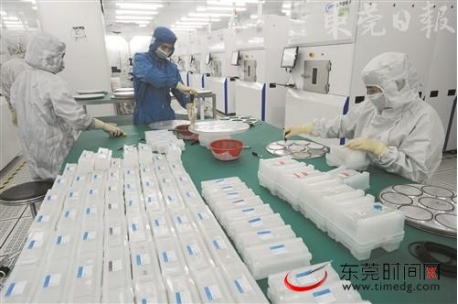
■ Production line of Dongguan Sino Patt Semiconductor Co., Ltd
On the morning of March 8 in the dust-free workshop of Dongguan Sino Patt Semiconductor Co., Ltd (hereinafter referred to as “Sino Patt”), a large number of etching machines were carving the same pattern on pieces of 4-inch patterned sapphire substrates (PSS). That was the automatic PPS production line of Sino Patt.
“We were able to industrialize the production of sapphire substrates based on our research findings,” said Liu Fengyi, GM Assistant of the Company. Sino Patt now produces over 45 million pieces of sapphire substrates (if converted to 2-inch sapphire substrates) a year. Its products are sold well at home and abroad, breaking up the monopoly of the market by its Japanese and German counterparts.
A dedicated sapphire substrate manufacturer for five years
Sino Patt has been specialized in the research, development and production of sapphire substrates since it was established in 2013. In the workshop of Sino Patt, one of its researchers showed the reporter a box of palm-sized sapphire discs as thin as a sheet of paper, saying that they were the substrates for making LED chips. It is understood that such a 4-inch sapphire disc could make up to 50,000 one-watt LED chips.
The Company encountered many difficulties right after its establishment. Though sapphire substrate technology has matured by then, production in China still suffered from high cost and low efficiency. Hence, how to make large-size sapphire substrates, improve the stability and uniformity of its production and develop products that enhance the luminous efficiency of LED chips have become the problems hindering the Company's future development. To break through this technical dilemma, Sino Patt formed a special sapphire substrate process and equipment team in 2014 by introducing high-tech technical talents from Taiwan and the Peking University.
The problem was resolved in no time as a new-type PSS preparation technology was developed the same year. “This new-type PSS was made through high-precision surface treatments on the sapphire substrate - carving accurate patterns of 1-2 microns using our proprietary etching technology.” There are roughly 1 billion graphical structures in a single 4-inch micro-level PPS, and they need to ensure that these structures are exactly the same, Liu explained.
“According to our epitaxial chip customers, compared to ordinary PSS, this new-type PSS can improve the luminance of LED products by 5%-10%.” Speaking of the technical breakthrough by their R&D team, Liu was filled with emotions. At present, LED technology and development has matured. In a fully competitive industry like the LED sector, a 2%-3% increase in light extraction efficiency would bring a greater competitive advantage to the customers.
Breaking international monopoly and achieving industrialization
Liu told the reporter that, before the Company was established, most of the sapphire substrate materials needed to be imported from Japan, Germany and other foreign countries. Due to technical reasons, only a few enterprises in China focused on LED substrate production and the domestic LED industry relied mostly on import for substrate materials.
Thanks to its research results in PSS, Sino Patt was able to realize the industrialization and extensive application of this material. In 2014, the Company's output for 2-inch sapphire substrates reached 2.29 million. Meanwhile, the breakthrough has won the Company attention and support from the Government of Dongguan City. In 2016, Sino Patt was granted the Second Prize of Dongguan Science and Technology Progress Award; in 2017, it was listed as a pilot of the Multiplication Plan of Dongguan. This year, it was winner of the 2018 National Scientific and Technological Invention Award.
The new-type PSS improved the luminous intensity as well as the service life of the LED chips. With full competition in this industry, this new-type cost-effective PSS could create greater competitive edge for LED chip manufacturers. As a result, enterprises started to offer olive branches to Sino Patt one after another. In 2016, the Company became the first Mainland material supplier for EPISTAR, a world leader in epitaxial chip technology. In 2017, Sino Patt became the No. 1 PPS supplier for EPISTAR. Sino Patt also made its way into the supply chain of world-famous manufacturers of LED epitaxial chips, such as Seoul Semiconductor and OSRAM. Its products find a ready market both in and out of China.
“With more than 45 million pieces of sapphire substrates (if covered to 2-inch sapphire substrates) made each year, we are now one of the largest PSS makers in the world. We also entered the international market by becoming recognized suppliers of overseas magnates.” According to Liu, Sino Patt has become the material supplier for 40-odd LED chip producers at home and abroad, including EPISTAR and HC SemiTek Corporation.
Due to technical breakthroughs and improvements in upstream LED materials, the downstream products, such as lamps, display screens and luminaire for auto lighting and UV sterilization, has also seen significant quality enhancement. “We will work to develop products with better cost performance. We will make the most of our micro/nano-level high-precision surface treatment technologies to explore new products and new applications”, said Liu expectantly about the future prospects of the Company.
About This Technology
Sapphire substrate is a core material for making LED chips
According to a researcher at Sino Patt, sapphire substrate is, for the moment, a core material for making LED chips. LED chip which is a crucial component to LED lights, mainly functions to convert the electrical energy into light energy. Substrates are key to making LED epitaxial chips as different substrates require different process technologies. For the time being, large-scale production can only be done on sapphire substrates; PSS is generally used in the industry for better luminous efficiency and fewer dislocation.
Source: www.timedg.com