According to the latest statistics released by the National Bureau of Statistics, China’s economic growth rate is shifted from negative to positive in the first three quarters this year with the national economy sustaining momentum of recovery. The International Monetary Fund recently predicted that China will emerge as the only major economy in the world that realized positive growth in 2020. This fully demonstrated adequate resilience and vitality of China’s economy.
In review of the 13th Five-Year Plan, China has been exposed to such circumstances as increasing external risks and challenges, reversing trend of economic globalization, and shocks induced by the COVID-19 pandemic. Nevertheless, China’s economy managed to develop steadily against all odds and made new progress.
During the 13th Five-Year Plan, China’s GDP has been increasing steadily. From 2016 to 2019, its average annual economic growth rate reached 6.7%, 3.9 percentage points higher than the world’s average. In 2019, China’s GDP was near 100 trillion yuan with the GDP per capita exceeding ten thousand US dollars. China contributed to around 30% to the world economy, emerging as the main driving force driving world economic growth.
In the meantime, the 13th Five-Year Plan period marks a transformative phase for China’s economy. Circular, systematic and structural conflicts are intertwined amid mounting downward pressure. China is at a critical juncture characterized by change of development mode, optimization of economic structure and shift of growth motivation. It is pointed out in the report of the 19th National Congress of the Communist Party of China that, “What we now face is the contradiction between unbalanced and inadequate development and the people’s ever-growing needs for a better life”, “China’s economy has been transitioning from a phase of rapid growth to a stage of high-quality development”. These are judgements made based on changes of international and domestic environments, especially changes of China’s development conditions and development stages.
High-quality development can meet the people’s ever-growing desire for a better life. It reflects the new development philosophy: In high-quality development innovation is the primary driving force; coordination is an endogenous feature; go-green is a prevailing mode; openness is the only path; and sharing is the fundamental goal.
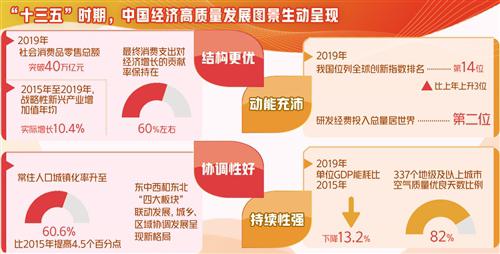
Guided by the new development philosophy, China’s economic structure is constantly optimized with the development quality and effectiveness being continuously improved. Domestic demand especially consumption plays a more prominent role in stabilizing economic development. In 2019, domestic demand contributed 89% to economic growth, among which the final consumption expenditure accounted for 57.8%. With the total retail sales of consumer goods reaching 41.2 trillion yuan, China has formed a market with a super large scale.
Industrial structure is also constantly optimized. China’s value added of the manufacturing industry also ranks first in the world for many consecutive years and the growth speed of the value added of the equipment manufacturing industry and high-tech manufacturing industry is faster than industries above designated size. The “stabilizer” role of the service industry is further enhanced, contributing 59.4% to the economic growth, 22.6 percentage points higher than the secondary sector of the economy. The value added of the service industry accounted for 53.9% of the GDP, 3.4 percentage points higher than that of 2015. The average growth rate of the emerging service industries such as information transmission, software and information technology in the past four years reached 19.4%, serving as fresh impetus facilitating constant growth of the service industry.
The achievements can be attributed to the constant enhancement of the endogenous development momentum. China takes supply-side structural reform as the main task and continues pushing forward reform of quality, efficiency and momentum in economic development.
During the 13th Five-Year Plan, China has been committed to building a modern economic system and effectively resolving overcapacity. China has made positive progress in destocking, deleveraging, addressing inadequacies and shoring up points of weakness. Cutting overcapacity in the steel and the coal industries during the 13th Five-Year Plan has been fundamentally accomplished with a barrage of “zombie enterprises” being cleared. Effective and middle- and high-end supply has been continuously expanding and the supply structure is increasingly adaptable to the demand structure.
In addition, advancements have been made in key areas such as reforms to streamline administration and delegate power, improve regulation, and upgrade services, reforms of state-owned assets and state-owned enterprises, reforms of fiscal revenue and tax distribution system and the financial system, and reform ofmarket-based allocation of factors. The business environment has been constantly optimized and notable results have been achieved from policies such as cutting taxes and fees and financial services targeted at the real economy. Economic and social development shows greater vitality.
Innovation is the primary driving force for development. During the 13th Five-Year Plan, China has been accelerating innovation-driven development and pursuing quality through scientific and technological innovation. Fruitful results have been achieved in making China a country of innovators. In 2019, China’s R&D expenditure reached 2.17 trillion yuan, accounting for 2.19% of the GDP. China’s proportion of the R&D expenditure in the GDP ranks second in the world and its innovation index ranks 14th in the world.
Ecological and environmental protection is an important symbol of high-quality development and is also an important means to facilitate high-quality economic development.The vision of green development was incorporated into the 13th Five-Year Plan for the first time. The past five years have seen China’s unprecedented development of ecological civilization with green becoming a distinctive feature of development. In 2019, the energy consumption of value added of enterprises above designated size was 15% lower than that of 2015. The air environment has been improved with the PM2.5 intensity being on gradual decline. In 2019, 337 cities above prefecture-level enjoyed good air quality on 82 percent of days.
During the 13th Five-Year Plan, China has been increasing investment in people’s livelihood projects and facilitating development of various social undertakings. People’s income continued to increase and poverty population further shrank. In 2019, Chinese residents’ per capita disposable income stood at 30,733 yuan, up by 5.8% than the previous year, growing along with the GDP and faster than the growth of GDP per capita. According to the latest statistics of the State Council Leading Group Office of Poverty Alleviation and Development, China has nearly accomplished its poverty alleviation objectives with existing problems of assuring the rural poor population that their food and clothing needs will be met and guaranteeing that they have access to compulsory education, basic medical services, and safe housing being all resolved. Industrial development shows sound momentum in poverty-stricken areas. Besides, China has also increased investment in aspects such as medical insurance and elderly care. Social security has been improved continuously and progress has been made in education, culture, health care and sports, which lay a solid foundation for improving people’s well-being and enrich the connotations of high-quality development.
The past five years have witnessed both hard work and glory. Standing at the new starting point, we are about to embark on a new journey of building a modern socialist country. Looking ahead of the 14th Five-Year Plan, we will uphold our long-term economic development guideline of pursuing high-quality development, implementation of new development concept and building a new development pattern.
It was pointed out at the meeting held by the Politburo of the CPC on July 30 that China has entered a high-quality development stage and enjoys favorable advantages and conditions in many aspects. At the same time, China still faces acute problems of unbalanced and inadequate development.
Liu Yuanchun, Vice President of Renmin University of China, expressed that, during the 13th Five-Year Plan, we have made scientific decisions based on scientific judgement and master of laws. Modern economic system has been continuously improved amid further reform and opening up, which demonstrates our institutional advantages. In the future, in the face of changes never seen in a century, external environment for China’s economic and social development has undergone profound changes. China needs to accelerate forming a new development pattern centering on internal circulation with the domestic and international markets promoting each other.
“We should continue adhering to the general work guideline of making progress while maintaining stability and focusing on supply-side structural reform.” Xu Hongcai, deputy director of the Economic Policy Commission with the China Association of Policy Science, expressed that we are still facing a period of strategic opportunities and we need to maintain the strategic focus and work hard to spur vitality of market entities and unleash various forces that are conducive to the development of social productivity.