Investment in Dongguan June 15, 2021
Dongguan’s 14th Five-Year Plan for National Economic and Social Development and the Long-Range Objectives Through the Year 2035
(Delivered and approved at the 7th meeting of the 16th People’s Congress of Dongguan Municipality on February 6, 2021)
This outline follows the guidance of Xi Jinping Thought on Socialism with Chinese Characteristics for a New Era and was formulated in accordance with the spirit of the 5th Plenary Session of the 19th CPC Central Committee, the spirit of the 12th Plenary Session of the 12th Guangdong Provincial CPC Committee, and the “Suggestions of Dongguan CPC Municipal Committee on Formulating Dongguan’s 14th Five-Year Plan for National Economic and Social Development and the Long-Range Objectives Through the Year”. This outline mainly clarifies guidance, fundamental principles, development goals, major strategies and major tasks for Dongguan’s economic and social development during the 14th Five-Year Plan period, and conducts outlook for the long-range objectives through the year 2035. The outline serves as important basis for the city’s strategic, programmatic and policy planning and represents the grand blueprint and action plan for Dongguan’s economic and social development in the next five years.
Chapter 1 Major achievements during the 13th Five-Year Plan period and development environment during the 14th Five-Year Plan period
During the 13th Five-Year Plan period, under the wise leadership of the CPC Central Committee, the State Council, Guangdong Provincial CPC Committee and the People’s Government of Guangdong Province, Dongguan people had made all-out efforts and achieved substantial progress in promoting economic and social development, laying a sound foundation for the 14th Five-Year Plan. As we enter the 14th Five-Year Plan period, we are facing a world that experiences tremendous changes. China will embark on a journey to fully build a modern socialist China on the basis of building a moderately prosperous society in all respects. Entering a new development phase, Dongguan will implement new development philosophy, promote high-quality development, and build new development pattern. Dongguan will seize the major strategic opportunities presented by the building of a pilot demonstration area of socialism with Chinese characteristics in Shenzhen and the Guangdong-Hong Kong-Macao Greater Bay Area. In the meantime, Dongguan also needs to tackle various risks and challenges never seen over a century in the world.
Section 1 Major achievements during the 13th Five-Year Plan period
During the 13th Five-Year Plan period, under the strong leadership of the CPC Central Committee with Comrade Xi Jinping as the core, Dongguan has practically strengthened consciousness of the need to maintain political integrity, think in big-picture terms, follow the leadership core, and keep in alignment with the central Party leadership; stayed confident in the path, theory, system, and culture of socialism with Chinese characteristics; and uphold General Secretary Xi Jinping’s core position on the Party Central Committee and in the Party as a whole, and upheld the Party Central Committee’s authority and its centralized, unified leadership. Dongguan has deeply implemented the decisions of the CPC Central Committee, the province’s “1+1+9” work deployment and the city’s “1+1+6” work approach, and steadily advanced coordination of epidemic prevention and control and economic and social development to effectively cope with grave tests posed by the COVID-19 epidemic and the China-US trade frictions and a series of major risks and challenges. Development of the “Thriving Dongguan, A Pearl in the Greater Bay Area” had been fully advanced and fresh progress had been made in high-quality development. Major objectives and tasks during the 13th Five-Year Plan had been fundamentally accomplished and decisive achievements had been made in building a high-level moderately prosperous society in all respects.
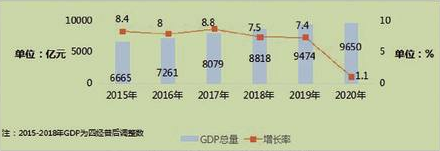
—Overall economic strength reaches a new level. Dongguan’s GDP has successively reached 700 billion yuan, 800 billion yuan and 900 billion yuan. Its GDP in 2020 reached 965.019 billion yuan, doubled that of 2020 in advance and its annual average growth stood at 6.5% for five years; its GDP per capita is expected to exceed 110,000 yuan, reaching the level of high-income economy. Its proportion of the primary, secondary and tertiary industry is 0.3:53.8:45.9. Dongguan’s tax revenue stood at 57.342 billion yuan, accounting for 7.9 of the province and 82.2% of the city’s general public budgetary revenue, ranking first in the province in terms of quality of fiscal revenue. Dongguan’s balance of deposit and loan of domestic and foreign currency respectively reached 1.8 trillion yuan and 1.2 trillion yuan, which were 1.8 times and 2.1 times of those of 2015. Dongguan had become the fourth prefecture-level city with a deposit of over one trillion yuan and the fifth prefecture-level city with a deposit of one trillion yuan in China. Dongguan has 58 enterprises going public at home or abroad and the number of enterprises going public at home witnessed multiplication growth for five consecutive years. Dongguan is home to more than 1.34 million market entities, accounting for 1% of the country’s total and ranking first among prefecture-level cities in the province. The number of Dongguan’s top 100 towns in China increased from 12 to 15 and all of its 28 towns rank top 400 along the top 1000 towns in China. Five of Dongguan’s towns and sub-districts are in the club with GDP worth of 50 billion yuan and the GDP of all its sub-developed towns exceed 10 billion yuan, representing a historical breakthrough. Dongguan ranks new first-tier city four years in a row, ranking No.10 in the country in terms of “Chinese city comprehensive economic competitiveness index”.
One hundred million
Percentage %
Note: The GDP from 2015 to 2018 was adjusted to integer after four economic census
GDP
Growth rate
Figure 1 Growth of GDP during the 13th Five-Year Plan period
—Major breakthrough has been achieved in building of innovative system. The world’s fourth and China’s first Spallation Neutron Source was built here in 2018 and was open to users across the globe. Songshan Lake Science City and Shenzhen Guangming Science City were incorporated into the comprehensive national science center in the Greater Bay Area as the pilot zone. Songshan Lake Materials Laboratory has become the first batch of provincial laboratory with 25 innovative teams being introduced and their research results first being elected as the “top ten progress in Chinese science”. Efforts have been made to accelerate building of Southern Photon Source research testing platform and steady progress has been made in planning for building of the Greater Bay Area University and City University of Hong Kong (Dongguan). Building of four major innovation systems of source innovation, technology innovation, results transfer and enterprise nurturing is gaining speed. The number of national high-tech enterprises has climbed to 6,381, 6.47 times of that of 2015, ranking third in the province. Dongguan boasts 23 national incubators, 439 provincial engineering centers, 26 provincial new type of research institutes, 2.9 times, 3.5 times and 1.5 times of that of 2015 respectively. R&D takes up 3.06%, reaching the level of developed countries. Dongguan was also approved of building itself as an important city equipped with national intellectual property rights operation service system; every ten thousand people possess 44.22 patents, 16.18 pieces more than the province’s average. High-level innovation fairs were successful hosted such as Guangdong-Hong Kong-Macao Academician Summit and Huawei Developer Conference. The “ten, hundred, thousand, ten thousand, million” talent project has shown preliminary results, attracting more than 50 academicians to conduct research activities in Dongguan on a regular basis. The city possesses more than 2.355 million talents, including 156,000 high-level talents, an average growth of 23.6%. Dongguan is equipped with 16 double employed academicians, 91 innovative research teams at city and province levels, and 123 leading talents at city and province levels. Building of a “city of skilled talents” has been advanced with skilled workers accounting for 22% of the industrial workers.
—Manufacturing industry shows prominent feature of high-quality development. Dongguan is home to over ten thousand enterprises above designated size and was awarded the title of National Quality City Demonstration City. A batch of industrial projects such as Huawei Device, Luxshare Precision, Lens Technology and Everwin Precision were completed and put into operation; 78 enterprises were among the top 500 enterprises in manufacturing of Guangdong, ranking second in the province. The GDP of industry above designated size exceeded two trillion yuan. Business revenue of enterprises above designated size in electronic information manufacturing industry exceeded one trillion yuan, and the three smartphone brands (Huawei, OPPO, vivo) fall into the “first camp” of global mobile phone brands, ranking top five in the world in terms of shipment. New generation of information technology, high-end equipment manufacturing, new materials, new energy, artificial intelligence, biomedicine and other industries are clustering at a faster speed with industrial bases for seven strategic emerging industries taking initial shape. Value-added of advanced manufacturing industry and high-tech manufacturing industry accounts for 50.9% and 37.9% of the value-added of industries above designated size respectively. The energy consumption per unit of GDP reduced by 20.53% in total and water consumption per ten thousand of GDP dropped by 36.1% in total.
—Prominent results have been achieved in comprehensively deepening reform. The provincial manufacturing industry supply-side structural reform innovation pilot zone was approved with 100 reform measures in areas such as shifting of new and old momentums and expansion of industrial space being launched. Important results have been achieved in a large batch of key reforms such as national new type of urbanization, coordination and optimization of functional areas with towns directly under administration of city and intensive land use. Deepening business system reform, stabilizing fundamentals of foreign trade, comprehensive reform of public hospitals and other works were provided with incentives by the State Council. Its project of deepening business system reform was elected as demonstration project of the country’s first batch of building government ruled by law. Dongguan ranked first among prefecture-level cities in the province in terms of comprehensive comments on convenience of starting a business for three years in a row and ranked first in the country in terms of government-business relationship health index for two straight years. Over the past five years, totally 16,578 domestic-invested projects were introduced with an actual investment of 477.5 billion yuan, an annual growth of 20.79%. Through reform of approval of engineering projects, time required for approval of social investment projects reduced by over 50%. Transfer registration of newly-built commercial housing can be settled within an hour in a working day. New policies on famers’ housing management were launched and implemented, and “one house for one household” and other policies were further optimized.
—New pattern of comprehensive opening up is taking shape faster. Following the launch and implementation of “Outline Development Plan for the Guangdong-Hong Kong-Macao Greater Bay Area”, mechanism of organization and implementation is constantly improved, and alignment with the systems and rules of Hong Kong and Macao is getting smoother. Efforts are made to support construction of Shenzhen Pilot Demonstration Are, and align with Guangzhou’s endeavors to unleash fresh vitality of the old city and pursue innovation and excellence in comprehensive city functions, overall cultural strength, modern service industry and modern international business environment. Efforts are also made to accelerate building of major platforms in the Greater Bay Area. Building of Songshan Lake Science City was elevated to national strategy; Binhaiwan New District was listed as a featured cooperation platform under the “Outline Development Plan for the Guangdong-Hong Kong-Macao Greater Bay Area” and provincial high-tech development zone; Shuixiang Economic Zone was elevated to provincial key development platform, and construction of Yinping Cooperative Innovation Zone was also accelerated. Dongguan’s values of import and export exceed 1.3 trillion yuan, ranking second in the province and fifth in the country. The size of Dongguan’s import and export in cross-border e-commerce also ranked among the top in the country. Humen Port Comprehensive Bonded Zone was officially put into independent customs operation. Dongguan has yielded fruitful results in participating in the construction of the “Belt and Road Initiative” with its values of import from and export to the countries along the “Belt and Road Initiative” increasing from 189.14 billion yuan in 2015 to 313.81 billion yuan in 2020, an increase of 65.9%; Totally 705 trains of China Railway Express were dispatched and 66,703 containers being sent, with exported goods worth of 3.21 billion US dollars. Dongguan ranked top three in the country in terms of competitiveness of top 100 foreign trade cities in China, emerging as the only comprehensive pilot city in Guangdong for building an open economic new system, with its pilot experience being promoted across the country.
—Connotations of city quality witness considerable improvement. The layout of urban core area consisting of central urban area, Songshan Lake and Binhaiwan New District has taken initial shape. Construction of “one center-two axes-three regions” is being advanced; city landmarks such as Minying International Trade Center had been successfully completed; development and construction of international business area had been fully commenced; development of regions such as south of Huangqi Mountain and “three rivers six areas” was substantially initiated. Efforts were made to innovate land requisition and reserve system with 44,000 mu of land being requisitioned and reserved by the city and towns. Citizen Service Center has become one of the province’s office halls with the most comprehensive departments, most items, and highest integration of comprehensive windows, setting a precedence in several respects such as shared number at both city and town levels and settlement of public security business through one window. The living environment is further optimized with actions of strengthening weak links such as “bathroom reform”, “clean city” and “five electric wire” treatment being steadily advanced. Totally 1,178 street landscapes were built; 1,756 public bathrooms were upgraded and rebuilt; 168 colorful forest projects were completed; 171 traffic congestion points and 102 waterlogging points were treated; 389 single villages of beautiful happy village (community) were completed with all villages (communities) reaching the standards of clean and tidy village. Dongguan has become the province’s only demonstration city with livable environment, winning title of national hygienic city five times in a row. Dongguan had also successfully hosted events such as FIBA Basketball World Cup, Asian Marathon Championships and volunteer service exhibition. Dongguan’s city image of vitality and positivity was further established.
—Modernization of infrastructure realized leapfrogged development. Transport sees smooth connection with both home and abroad. Construction of Dongguan section of the Ganzhou–Shenzhen high-speed railway, Dongguan section of Shenzhen-Maoming Railway and Dongguan section of Foshan-Dongguan intercity railway is being facilitated faster. Construction of Lion Ocean Bridge and Lianhuashan River-crossing Expressway is under planning. Guangzhou-Shenzhen intercity railway and Dongguan-Huizhou intercity railway were completed and put into operation. Nansha Bridge, the first phase of Dongguan-Panyu Expressway and Huadu-Dongguan Expressway were completed and put into operation. During the 13th Five-Year Plan period, totally 120 kilometers of intercity railway and about 87.39 kilometers of expressway were built with the traffic network of integrating into the one-hour life circle in the Greater Bay Area being formed faster. The city has entered the “metro era” following the completion and opening of Metro Line 2 and the comprehensive commencement of construction of the first phase of Metro Line 1. Six stations connecting with Guangzhou and Shenzhen respectively are under planning and construction. Function of harbor as regional hub has been greatly improved. Dongguan Port is equipped with a cargo throughput of 199 million tons and a container throughput of four million twenty-foot equivalent units, ranking top 50 among container ports in the world. The energy supply system had been further optimized: 5 coal-fired power plants with totally 1,330 megawatt in Shajiao Power Complex were closed as scheduled; construction of the Ningzhou plant electricity replacement project is being accelerated. Network of water infrastructure has become more complete with the construction of the Pearl River Delta water resources allocation project (Dongguan section) being commenced. During the 13th Five-Year Plan period, totally 96.44 kilometers of dyke project had been completed and 2,656.69 kilometers of water supply pipes and network had been renovated and rebuilt. Construction of information infrastructure has been advanced: penetration rate of fixed broadband reached 100% in Dongguan households; penetration rate of mobile broadband users reached 171.1%; 5G network has covered key industries and core urban areas.
—Historical breakthrough has been made in pollution prevention and control. Unprecedented efforts had been made to treat water pollution with weak links being strengthened. Totally 70 billion yuan has been invested within five years with 12,000 kilometers of sewage pipes being newly built, 18 sewage disposal projects being newly built or expanded, 35 sewage disposal plants being improved and rebuilt, 182 quarries being cleaned, 424 polluted rivers being treated, water quality of seven national and provincial sections passing relevant standards, and odor of 22 black and odorous rivers in the urban area being eliminated. Water quality of key regions such as Maozou River and Shima River has been improved prominently. Fundamental changes have taken place in the city’s quality of ecological environment and the images of clean waters and green banks are re-emerging faster. Dongguan had won titles such as “National Water Ecological Civilization City” and “National Water-Conserving City”. People’s sense of accomplishment and satisfaction has been considerably improved. Consistent efforts had been made in blue sky protection campaign: 56,000 poorly managed - and polluting - small enterprises had been treated; more than 17,000 enterprises with emissions of volatile organic compounds (VOCs) were treated; coal consumption had been cut by over 6.5 million tons; 75,000 yellow-label vehicles (higher-emission vehicles) and old used vehicles had been cleaned up off the road; electrification rate of public transports reached 100%; good air quality on 91.3% of days had been realized; the average PM2.5 concentrations had been dropped by 24 µg/m3, reaching a historical low. “Dongguan blue” was frequently shown by people via social media platforms. Disposal capacity of domestic waste, hazardous waste and domestic sludge had been improved by 93.5%, 127% and 171% respectively compared to 2015. Full incineration and zero landfilling had been realized for extra domestic waste; resource recovery had been achieved from construction waste; fly ash disposal project had been introduced for the first time; and 36 landfill sites at both city and town levels had been treated. Industrial protection redline with an area of 420 square kilometers, 306,000 mu of permanent basic farmland and marine ecological redline had been delimitated. Treatment of mountain-river-forest-field-lake-grassland had been advanced in a coordinated manner. Fourteen forest parks and wetland parks had been newly built: Huayang Lake had become national wetland park; Qingxi Town as graded as Global Green Town by the United Nations Human Settlements Program. The urban green ratio reached 42% with per capita public green space reaching 19.83 square meters. Green is becoming the brightest background color of the city.
—Major victory had been achieved in the drive of building a moderately prosperous society in all respects. Unprecedented efforts had been made to ensure people’s wellbeing. Totally 203.7 billion yuan had been invested by Dongguan Finance Bureau for improving people’s wellbeing with expenditure accounting for more than 70%. People’s quality of living has witnessed constant improvement: residents’ per capita disposable income stood at 56,533 yuan, up by 46.3% compared to 2015. Social assistance system has been improved and expanded by coverage with full coverage of old-age insurance being realized. Public services witness continuous optimization and improvement: 180,000 enrolment places of public and private schools in the stage of compulsory education had been newly added; more than 6,000 hospital beds had been added; 4,266 elderly-care beds had been added; respectively up by 19.4%, 23% and 56%. Allowances for children living with their migrant worker parents enrolling in public and private schools reached 50% of the provincial objective. Medical conditions were improved faster: construction of high-level hospitals was commenced; construction of five central hospitals in the region was steadily advanced; standardized construction of community health service institutes had been completed; major strategic achievements had been made in COVID-19 epidemic prevention and control. Cultural undertakings continue flourishing: Dongguan has become national public culture service standardization demonstration area with value-added of culture industry in GDP increasing to 6.05%, ranking third in the province; Dongguan has successfully built itself into a National Copyright Demonstration City. Dongguan ranked first in the province in terms of people’s satisfaction regarding results of special criminal syndicate combat; results of crackdown on sex trade had been constantly consolidated; further efforts had been made to build a civilized city; Dongguan had won the title of “National Civilized City” for five years in a row; “national social governance innovation demonstration city” for four consecutive years; “national double support model city” for nine straight years; and the highest honor of comprehensive treatment, “Chang’an Trophy”. Decisive achievements had been made in the task of eliminating poverty in a targeted manner: through pairing support, 821,800 poor people in Zhaotong were steadily lifted out of poverty; all the 874 poor villages and six poor counties had all been lifted out of poverty. Clear progress had been made in Jieyang and Shaoguan in poverty elimination through pairing support. A total investment of 1.5 billion yuan had been made for pairing support for Xinjiang, Tibet and Sichuan. The city’s practice “pairing assistance between villages” had been fully recognized and promoted by the country. Dongguan’s capability of diffusing major risks has been further improved; internet financial risks had been fundamentally cleared; “Tuandai.com” cases had been effectively tackled; government debt rate is lower than the average of both the province and the country. Economy and society see sound and stable development.
Table 1 Dongguan’s completion of major targets during the 13th Five-Year Plan
Notes: 1. Figure within the [] refers to cumulative number, figure with * refers to figure in the year 2019 or the cumulative amount by 2019.
2. The target of invention patent, proportion of value-added of service industry in GDP, forest stock volume, reservation of arable land, number of national high-tech enterprise and number of beds for elderly care every one thousand senior citizens refers to figure through mid-term assessment adjustment.
3. Indices of GDP, proportion of value-added of service industry in GDP, Proportion of modern service industry in service industry, proportion of value-added of advanced manufacturing industry in value-added of industries above designated size, proportion of value-added of high-tech manufacturing industry in value-added of industries above designated size represent preliminary statistics of completion in 2020.
4. Due to the seventh national population census, the population statistics in 2020 have not been released. The corresponding completion figure of per capita GDP and completion of urbanization rate of residential population is vacant temporarily. The 2020 completion of the number of Practicing (Assistant) physicians every one thousand people is a predicted figure.
5. Due to the third national land survey, the statistics of reservation of arable land in 2019 and 2020 are yet to be released.
6. The final verified statistics of the province shall prevail with regard to accessibility of urban broadband, proportion of expenditure of R&D in GDP, invention patent, decrease of energy consumption per unit of GDP, decrease of water consumption per ten thousand yuan of GDP and decrease of emission of major pollutants.
7. The completion in 2020 of forest development index will be revised according to the latest statistics of forest resources in the third national land survey.
8. Due to reasons such as cancellation of statistics of prefecture-level cities, feedback of fundamental statistics, unclarified statistical indicators and adjustment of municipal policies, the 2020 statistics for indices such as contribution rate of science and technology progress, higher education gross enrollment ratio, proportion of non-fossil fuel in consumption of primary energy and leading talents of innovation and entrepreneurship are currently short of.