Investment in Dongguan July 16, 2021
On July 14, Dongguan Development & Reform Bureau released the “Notification on Adding the City’s Second Batch of Major Projects in 2021”. Projects such as the second phase of Cineng Automation Equipment were added as the city’s major construction projects or preparation projects, with the total investment reaching about 24.6 billion yuan.
During the 13th Five-Year Plan, Dongguan’s economy experienced continuous growth with its GDP reaching 700 billion, 800 billion and 900 billion yuan successively, heading towards the target of one trillion yuan. Dongguan’s GDP per capita also successively surpassed 90,000, 100,000 and 110,000 yuan, higher than the province’s average, reaching the level of high-income economy.
In 2020, Dongguan’s GDP reached 965.19 billion yuan, accounting for 0.9% of the country’s GDP; Dongguan’s tax income stood at 215.319 billion yuan, accounting for 1.6% of the country; total value of export reached 828.155 billion yuan, accounting for 4.6% of the country’s total value of export.
The above statistics show that Dongguan contributes prominently to the whole country in economy, providing strong support for Guangdong in its drive to lead the country and make fresh progress in the country’s course of fully building a modern socialist China.
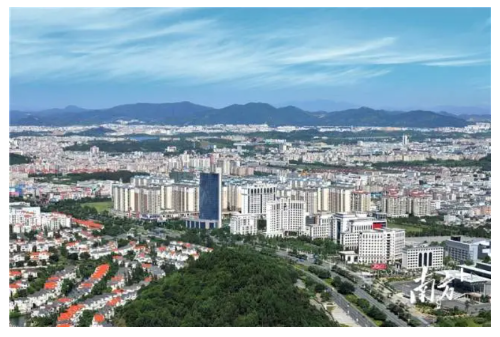
Dongguan is now striving to become a member in the club with GDP of one trillion yuan. Its soaring GDP reflects its metamorphosis to high-quality economic development: constant optimization of economic structure, accelerating shift of new and old momentum and increasing improvement of quality and effectiveness.
GDP moving up to one trillion yuan
Observing Dongguan’s experience of changes through statistics
On July 13, Statistics Bureau of Dongguan Municipality released “Analysis of Dongguan’s Investment in Fixed Assets During the 13th Five-Year Plan”. According to statistics, Dongguan has totally accomplished an investment of 961.522 billion yuan. Its steadily increasing total investment gives strong boost to its economic development.
In fighting for a GDP of one trillion yuan, Dongguan not only managed to realize soring GDP but also present continuous optimization of industrial structure, showing applaudable new momentum, new forms of business and new progress in quality and effectiveness.
Dongguan is now witnessing constant optimization of industrial structure and improvement of industrial system.
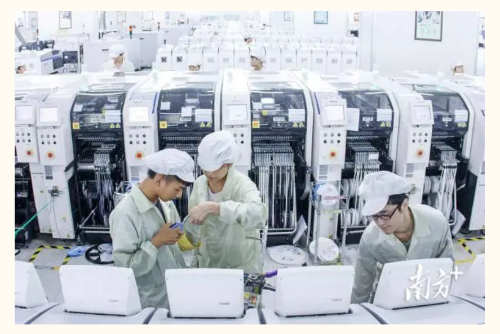
Regarding industrial structure, the ratio of Dongguan’s three tiers of industrial structure has been adjusted from 0.3:52.2:47.5 in 2015 to 0.3:53.8:45.9 in 2020, with the ratio of the secondary industry increasing by 1.6 percentage points. In 2020, the added value of theadvanced manufacturing industry and the high-tech manufacturing industry accounting for 50.9% and 37.9% of the industries above designated size respectively. Dongguan’s modern service industry accounted for 63.8% in its tertiary industry in 2020. Its service industry is moving towards high-quality development on a continuous basis.
In terms of industrial system, by the end of 2020, Dongguan possesses 565 subcategories of manufacturing industry with 92.8% of industry coverage. It has formed a modern industrial system with electronic information manufacturing industry as the pilot and a relatively comprehensive industry chain. Over the past five years, the gross output value of Dongguan’s industries above designated size had surpassed two trillion yuan, increasing from 1.274442 trillion yuan in 2015 to 2.160797 trillion yuan in 2020, average annual growth of 8.5%. Dongguan’s market vitality has also been constantly strengthened. In 2020, Dongguan boasted 10,861 enterprises above designated size, ranking second among prefecture-level cities and above. Also in the same year, Dongguan’s smartphone production reached 316 million with the shipment of three brands ranking top five in the world, indicating Dongguan’s leading position in smartphone industry around the world.
Dongguan’s three drivers of economy, namely investment, export and consumption, show sound prospects with unremitting vigor.
Dongguan continues releasing consumption potential. In 2020, Dongguan’s total retail sales of consumer goods reached 374.014 billion yuan, increasing by 42.6% compared to 2015, average annual growth of 7.4%, ranking second in the province in terms of average annual growth rate.
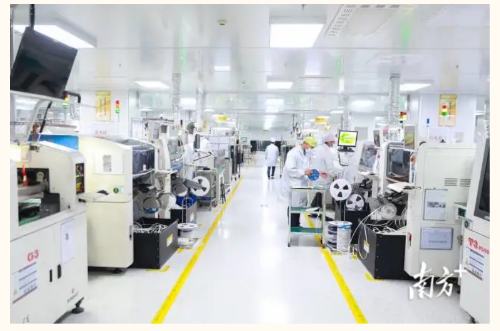
Dongguan’s investment in fixed assets is strongly powered.Dongguan’s investment in fixed assets stood at 144.652 billion yuan in 2015 and 240.510 billion yuan in 2020, increasing by 66.4% compared to 2015, average annual growth of 10.7%. Totally an investment of 961.522 billion yuan had been completed. Dongguan actively implemented three-year action plan for improving city quality, which effectively boost potential and vigor of private investment. From 2016 to 2020, private investment in Dongguan had completed 621.559 billion yuan, an average annual growth of 10.6%. The rapid growth of private investment had expanded space and accumulated strength for Dongguan’s private enterprises, which effectively promotes sustainable and healthy development of Dongguan’s economy.
Dongguan actively introduces and utilizes foreign investment to improve trade performance. In 2020, Dongguan’s total value of import and export reached 1.330303 trillion yuan, ranking fifth in the country. From 2016 to 2020, totally 4,695 projects had utilized foreign investment with the actual utilization of foreign investment standing at 55.170 billion yuan. Dongguan has been constantly advancing building of a new system for open economy. Since becoming a pilot city of building a new system for open economy in May 2016, Dongguan has further deepening reform and opening up to form new advantages for development of foreign trade.
Dongguan insists on innovation-driven development, which drives rapid development of new technology and new forms of business.
Driven and supported by innovation, Dongguan is accelerating transformation and upgrading of industrial structure and facilitating building and improvement of an innovation system to build a national innovative city. Dongguan’s R&D expenditure increased from 14.788 billion yuan in 2015 to 28.996 billion yuan in 2019, with the ratio in the GDP being elevated from 2.22% in 2015 to 3.06% in 2019, reaching level of developed countries.
Relying on nurturing emerging industries, Dongguan is promoting growth of new forms of business and new momentum. Its emerging industries see rapid increase of market entities. By the end of December 2020, Dongguan possessed 57,700 entities under category of emerging industries, representing 4.6 times of 2015 and an average annual growth of 35.8%. In 2020, Dongguan possessed 6,385 high-tech enterprises. Dongguan’s transaction value of e-commerce reached 586.1 billion yuan, with value of import and export in cross-border e-commerce accounting for 38.06 billion yuan, ranking first in the country in size.
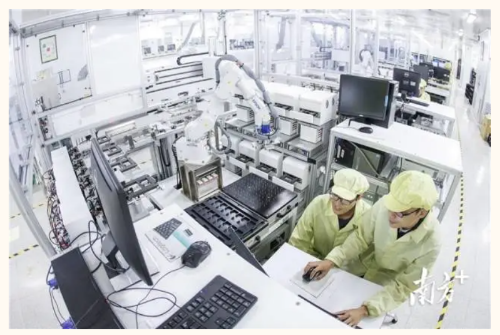
Dongguan’s economic development enjoys comprehensive improvement in both quality and effectiveness from being fast to sound.
In pursuing high level of development, Dongguan is promoting increase of productivity of social labor with constant increase of GDP output per unit of land and constant drop of energy consumption per unit of GDP, driving considerable improvement of the city’s quality of economy. Through continuous transformation and development and comprehensive implementation of policies such as “Dongguan manufacturing+”, “Multiplication Program” and “replacement of humans with robots”, Dongguan’s productivity of social labor in 2020 increased by 38.4% compared to 2015 with an average annual growth of 6.7%.
Resulting from Dongguan’s improvement of intensive land use, Dongguan’s high-tech industry and tertiary industry see fast development with GDP output per unit of land increasing from 580 million yuan per square kilometer in 2015 to 810 million yuan per square kilometer in 2020. Dongguan’s economic growth shows reducing dependence on energy consumption. Dongguan’s energy consumption per unit of GDP in 2020 stood at 0.333 tons of standard coal per ten thousand yuan, 20.5% decrease compared to 2015 (0.453 tons of standard coal per ten thousand yuan), the lowest level over the past five years.
Leading the country in technological innovation
Upgrading development through technological innovation
“Many unpleasant, exhausting and dangerous tasks can be delegated to robots. When I decided to start my own business, I aimed at the large market of ‘replacing humans with robots’,” said Tang Kangshou, CEO of Dongguan Zhongtian Automation Technology Co., Ltd.
Not long ago, the high-speed rail grinding R&D and application project, jointly developed by the company, Guangzhou University and China Railway Guangzhou Group, won the second prize of Guangdong provincial science and technology progress award. It is expected that replacement of humans with robots can be realized in the field of high-speed rail grinding.
According to Tang Kangshou, Zhongtian Automation has been focusing on griding of 3C products, lithium batteries and auto parts, taking a relatively large market share in the market segment.
“Many components need to be welded together to form a whole steel rail in the process of producing high-speed rail. Our company’s technology can be used for welded seam to make the rail smooth.” Tang Kangshou said, “High-speed railway is under the category of national engineering project. If the company’s project can be put into operation, automation in the field of grinding of high-speed rail can be realized, which will make the high-speed railway much safer.”
Dongguan’s scientific and technological innovation is on a fast track since it started building itself into a national innovative city following the approval by the Ministry of Science and Technology and the National Development and Reform Commission.
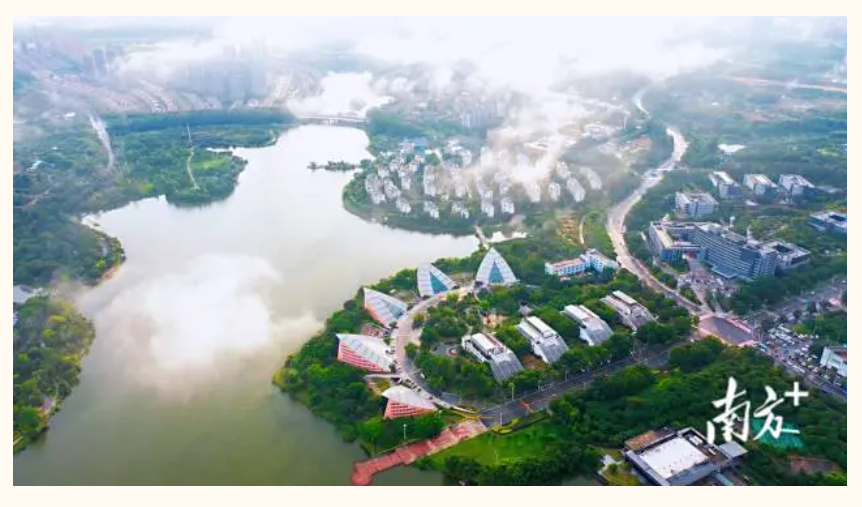
“Scientific and technological innovation is a systemic project. We need to seek upgrading and transition through breakthrough in points to system.” According to people in charge from Dongguan Science and Technology Bureau, Dongguan upholds the positioning of “technology innovation + advanced manufacturing” to advance optimization and rebuilding of whole-chain innovation system. It endeavors to from a whole-chain innovation system that covers “source innovation-technological innovation-results transfer-enterprises nurturing”.
Dongguan is expanding source of innovation and has assumed the important task of building a pilot zone of national comprehensive science center in the Greater Bay Area by planning an area of 90.52 square kilometers to build Songshan Lake Science City. The country’s first and the world’s fourth Spallation Neutron Source scientific apparatus had been installed and put into operation. Centering around major demands of the country and the world, the apparatus has completed nearly 500 projects and provides experimental tests for leading enterprises such as Huawei and Tsinghua Unigroup. In addition, it has also independently developed China’s first medical accelerator BNCT experimental equipment, bringing major technological revolution in nuclear medicine and cancer treatment.
At present, Dongguan is accelerating construction of the second phase of Spallation Neutron Source, pre-research platform of Southern Photon Source and advanced attosecond laser equipment in an effort to form an exclusive function portfolio featuring “super strong, bright and fast” in observing the micro structure of substances and providing powerful tools for basic research and frontier interdisciplinary research. Dongguan is also actively introducing new type of research-oriented universities through building of the Greater Bay Area University and the City University of Hong Kong (Dongguan), and supporting Dongguan University of Technology in building itself into a demonstration university as a new type of high-level STEM university.
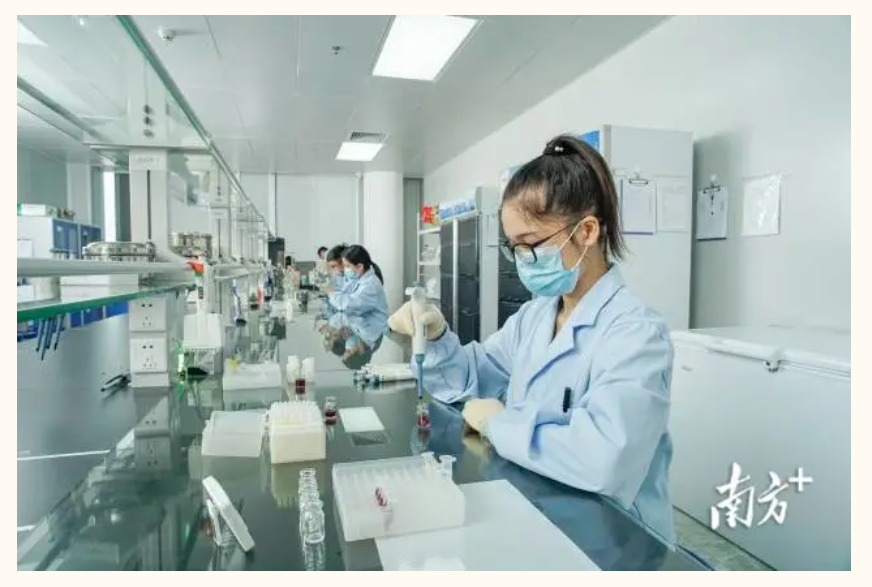
Dongguan is seeking breakthrough in technology by deploying frontier interdisciplinary research platform, which provides support for breakthrough in industrial application. Songshan Lake Materials Laboratory has introduces over 800 researchers undertaking 75 key R&D projects of the country and the province. The research results of the laboratory had been elected as China’s Top 10 Science Advances in 2019 of the Ministry of Science and Technology and China’s Major Technology Advances in 2020 of China Association for Science and Technology; led by Zhao Zhongxian, winner of the Highest Science and Technology Award, Dongguan managed to develop an advanced laser coating equipment based on homegrown components, and large-size high-quality superconducting single-crystal thin film was manufactured, which eliminated foreign embargo and technology monopoly.
Dongguan is accelerating results transfer by building channels for technology R&D and results transfer. Dongguan has collaborating with renowned higher institution in China in building 33 new types of R&D institutes. There emerge a batch of representative institutes such as Guangdong HUST Industrial Technology Research Institute and Songshan Lake International Robot Research Institute. These new type of research institutes serve over 20,000 enterprises and have incubated more than 1,600 enterprises. Thus they are important composition of Dongguan’s regional innovation system.
Dongguan is stepping up nurturing of enterprises and has formed a matrix of innovative enterprises consisting of technology-typed small- and medium-sized enterprises, high-tech enterprises, gazelle enterprises, top 100 innovative enterprises and listed enterprises.
Dongguan is home to 6,385 high-tech enterprises, ranking second among prefecture-level cities and yielding output value of over 1.2 trillion yuan. Dongguan’s industrial enterprises above designated size have totally built 4,721 research institutes, with a construction rate of 39.4%. Dongguan boasts 439 engineering centers abive provincial level. Shengyi Technology and HEC Group have respectively built National Engineering Technology Research Center and State Key Laboratory, giving strong support to R&D and innovation of enterprises.
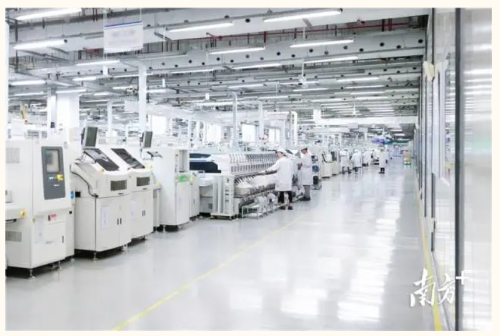
According to evaluation of an authoritative institute, Dongguan ranks seventh among prefecture-level cities in the “2020 China City Technology Innovation Development Index” and 22nd in the “2020 National Innovative City Innovation Capability Assessment Report”.
Optimization and rebuilding of whole-chain innovation system has been empowering high-quality development of economic industries. During the 13th Five-Year Plan, Dongguan’s R&D ratio in GDP increased to 3.06%; and the energy consumption per unit of added value of industries above designated size dropped by 20.5%. The added value of the city’s advanced manufacturing industry and high-tech manufacturing industry respectively accounted for 50.9% and 37.9% of the added value of the industries above designated size.
Presenting a brighter image in advanced manufacturing industry
Writing a new chapter of high-quality development
On June 17, the Shenzhou 12 crewed spaceflight sent three taikonauts to the space from Jiuquan Satellite Launch Center. The core module of Chinese space station will embrace the arrival of the first batch of taikonauts who will embark on a three-month life in the space, creating China’s new heights in the space cause.
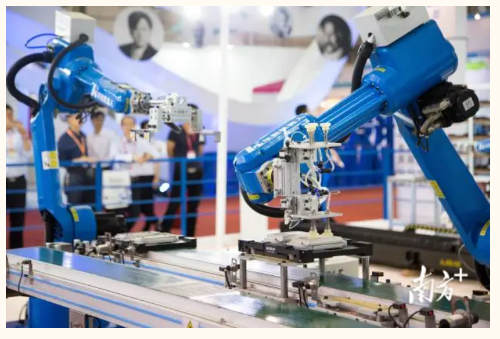
More than 3,200 miles away in Dongguan, Guangdong Topstar Technology Co., Ltd. (hereinafter referred to as “Topstar”) is speeding up production of molding machines. What merits attention is that it was Topstar that manufactured the molding machine used for producing the communication caps for the three taikonauts of the Shenzhou 12 crewed spaceflight for communicating with the Earth from the space.
“I am honored to contribute to China’s space cause,” said Wu Fengli, President and CEO of Topstar. “My aspiration of starting my business is to make industrial manufacturing become better and advance China’s progress in industrial technology so as to better power high-quality development of China’s advanced manufacturing industry.”
Lin Jiang, Professor of the Department of Economics of Lingnan College, Sun Yat-sen University, expressed that the presence of Dongguan’s advanced manufacturing industry in China’s space endeavor shows Dongguan’s important role in serving as a major city in the world’s manufacturing industry. It also indicates that Dongguan is upgrading from being a hub of processing manufacturing industry to a hub of advanced manufacturing industry. Meanwhile, this also gives Dongguan’s manufacturing a shot in the arm and encourages more enterprises in Dongguan to make consistent efforts to transform and upgrade and facilitate high-quality development of manufacturing industry, proving support for Dongguan in building a hub of advanced manufacturing industry in the Guangdong-Hong Kong-Macao Greater Bay Area.
Dongguan’s advanced manufacturing industry is making continuous contributions to China’s space cause and high-quality development of manufacturing industry. During the 13th Five-Year Plan, the gross output value and the added value of Dongguan’s industries above designated size respectively increased from 1.46925 trillion yuan and 296.82 billion yuan in 2016 to 2.1608 trillion yuan and 414.56 billion yuan in 2020.
Who could imagine that over 40 years ago Dongguan was merely a rural county. Through reform and opening up, Dongguan has transformed into a world-famous manufacturing city and has formed a manufacturing system with relatively comprehensive categories, covering 24 major industry categories with over 60,000 kinds of products.
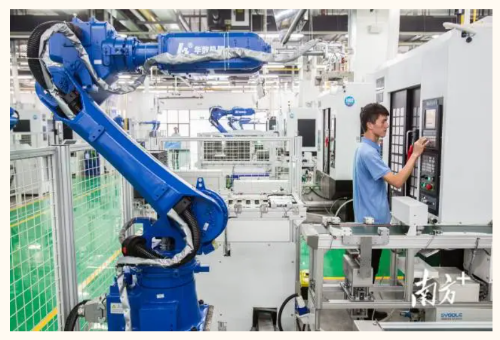
New momentum has become new areas of growth for Dongguan behine the reform of supply in manufacturing industry. This year, the People’s Governmemnt of Dongguan Municipality has specially included building new momentum in the No.1 central document, providing powerful support for Dongguan in building the advanced manufacturing hub in the Guangdong-Hong Kong-Macao Greater Bay Area. The No.1 central document has given priority to “building new momentum” in the transformation and development in the next five years.
The blueprint of new momentum with advanced manufacturing industry as the core has amazed the whole world —
Valuing over one hundred million yuan, Dongguan’s digital economy in 2019 ranked top in the second gradient of digital economic development in the Guangdong-Hong Kong-Macao Greater Bay Area, following Shenzhen and Guangzhou in the province; Dongguan’s lithium battery industry was valued over 50 billion yuan in 2019 with the output value of lithium batteries for consumer electronics ranking second in the country; Dongguan’s output industrial robots in 2020 accounted for 5.1% of the country’s total output of industrial robots, representing 17% of that of the province…
As it embarks on the 14th Five-Year Plan, Dongguan is fighting for the target of becoming a national metropolis of advanced manufacturing driven by technological innovation. By implementing a development project of a “strong, large, precise and high-quality” industrial system, Dongguan is striving to add five or more industrial clusters worth of over one hundred bullion yuan and build a modern industrial system with advanced manufacturing as the core and international competitiveness with diversified support.
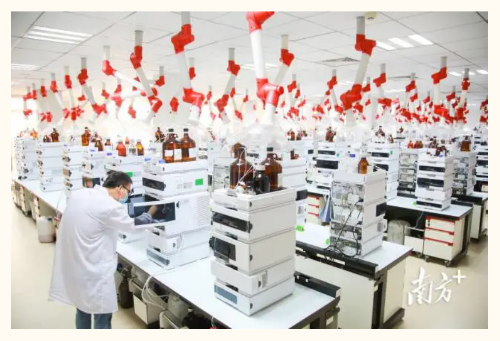
In April this year, the results of the competition among industrial clusters in the field of modern advanced manufacturing industry that lasted for two years and represented the highest level in the country were freshly released. According to the “Disclosure of Lists of Winners in the Final of Advanced Manufacturing Industrial Clusters” released by the Ministry of Industry and Information Technology, two advanced manufacturing industrial clusters from Dongguan stood out, namely, Guangdong Province Dongguan smart mobile terminals cluster and Guangdong Province Guangzhou Shenzhen Foshan Dongguan smart device cluster.
The inclusion of the two advanced manufacturing industrial clusters into the “national team” represented recognition of development achievements of Dongguan’s advanced manufacturing industrial clusters. This also exerts important implications for Dongguan in building a leading modern industrial system with diversified support in the country and the world, improving core competitiveness of industries and boosting high-quality economic development.
Tangxia Town is a traditional industrial town in Dongguan. Advanced manufacturing industry is becoming a major development driver for Tangxia Town since it seized the priority in industrial transformation and upgrading in the past few years. This can be reflected by a series of projects from the 15 projects of major industries with a total investment of about 35.844 billion yuan attracted by the new generation of electronic information industry base adjacent to Shenzhen, to the four projects with a total investment of 5.6 billion yuan signed on the site of the city’s investment promotion conference on strategic emerging industries, and to the accelerating construction of 22 key industrial projects… Since last year, Tangxia Town has facilitated concentration and settlement multiple major projects, presenting satisfying results to the city.
Advanced manufacturing industry has become a pivot for Dongguan’s development. Dongguan needs to strengthen competitiveness of its products and build itself into a hub of advanced manufacturing industry in the Guangdong-Hong Kong-Macao Greater Bay Area to write a new chapter of high-quality development in manufacturing industry.
Stories of getting well-off
Connected land in Xiaohe Village for project of “transforming and upgrading existing industrial land” to be built as 5G demonstration base of intelligent manufacturing
Nurturing a hen that lays eggs for the villagers
Streams of vehicles moving along and train on the intercity railway passing by at the intersection of Guangshen Expressway and Dongguan–Huizhou intercity railway, the two traffic arteries of the Guangdong-Hong Kong-Macao Greater Bay Area. Xiaohe Village adjacent to Daojiao Town was on the first ride of Dongguan’s new round of transformation of industrial parks of towns and villages.
The project of “transforming and upgrading existing industrial land” on the connected land in Xiaohe Village represented Dongguan’s first project of “transforming and upgrading existing industrial land” that adopted the city’s state-owned land. Land preparation, development and transformation of the project were done by Dongguan Qisheng Investment Development Co., Ltd. jointly established by Dongguan Industrial Investment Holding Group and the People’s Government of Daojiao Town. Lijiangwei Village Group, where the initial phase of the project is situated, had seen demolition of disordered old industrial factories. A neat block with an area of 150 mu is ready for getting examination and approval related to land supply.
“Building of the Greater Bay Area delivers unprecedented development opportunities. We are finally catching up and we are grateful for such great opportunities given by the city and the town,” said Lu Zhiming, Secretary of the village Party Committee of Xiaohe Village.
Lijiangwei industrial area, the predecessor of Xiaohe project, was built in the 1990s, with factories covering an area of 72,000 square meters. Most factories were one-floor metal plate buildings. The land use was extensive and the industries involved were backward and polluting industries such as shoe materials and hardware processing with annual output value of merely 18 mullion yuan. Lu Zhiming said he was concerned seeing failure in attracting and retaining outstanding enterprises and the withdrawal of enterprises growing in size.
In the future, Xiaohe project will rely on the foundation of industries such as graphene new materials and the 5G industry resources of Dongguan Industrial Investment Holding Group to build a demonstration base empowered by 5G intelligent manufacturing in the Greater Bay Area. The demonstration base is expected to yield an annual output value of 1.5 billion yuan and contribute over 50 million yuan and about 4,000 jobs. Lu Zhiming said that lately Qisheng company had taken representatives from large enterprises to visit the site of the project frequently, which bolstered his confidence in new hopes of Xiaohe Village.
The project of “transforming and upgrading existing industrial land” on Xiaohe connected land has been gaining speed due to Dongguan’s policies for a new round of rebuilding and upgrading industrial parks of towns and villages. In January last year, Qisheng company and the economic union of Xiaohe Village (branch union of Lijiangwei) officially signed agreement on rebuilding; in August, property demolition works were launched; in November, signing of agreements concerning private blocks had been completed; in March this year, demolition and land preparation for Xiaohe project had been completed; the project is expected to see construction commencement in September this year.
Growing the cake and sharing benefits with the villagers’ group, original stakeholders and villagers are important reasons for Xiaohe project to win support and experience fast advancement.
Villager Mingshu (nickname) owned an old factory with an area of 2,000 square meters in the original industrial area, and he got a rent of over ten thousand yuan every month. According to the compensation principles of “separation compensation for building and land” in the signed agreement, aside from cash compensation of several millions for his demolished properties, Mingshu could also get compensation of new type of factory property with an area of 1,000 square meters in the newly built high-end industrial park. He could get monthly income of nearly 200,000 yuan according to the market price of rent of 15-20 yuan per square meter.
The villagers’ group can also get a lump sump industrial factory buildings with an area of 15,000 square meters, 7,000 square meters market property compensation and 32 million of cash compensation. The annual rent is going to quadruple on the basis of the original 2.8 million yuan. In addition to the tangible income, influx of talents resulting from high-end enterprises also delights Lu Zhiming. “The arrival of talents will also contribute to improvement of the village’s civilized aspects, increase of property income from rent of villagers’ apartments and more develop opportunities in service industry.”
He vividly said, “It can be said that the government and Dongguan Industrial Investment Holding Group had raised a hen that lays eggs for the villagers.”
Source: Nanfang Plus